Don't Buy the Airmega 200M Until You Read This Full Analysis
The air purifier market is currently experiencing a renaissance of accessibility. What was once a niche appliance relegated to medical environments or high-end custom homes has now become a staple of the modern household. As urban density increases and environmental factors like seasonal wildfires and pollen counts become more aggressive, the average consumer is faced with an overwhelming array of choices. Amidst this crowded field, the Airmega 200M has emerged as a frequent recommendation for those looking for a balance of power and price. However, picking a piece of electronics for your home involves more than just looking at a spec sheet; it requires understanding how that device fits into the rhythm of your life, your budget, and your specific air quality concerns.
The Airmega 200M occupies a unique space in the lineup from Coway, a manufacturer known for dominating independent testing lists for years. It is essentially a modernized relative of the classic Coway AP-1512HH Mighty, sharing much of the same internal architecture while offering a different visual aesthetic. But is a different case and a slight tweak in interface enough to justify its place in your home? This analysis dives deep into the performance metrics, the operational costs, and the distinct user experience of the 200M to determine if it is the right solution for your indoor environment or if you should keep looking.
Understanding the Core Technology
At the heart of the Airmega 200M is a traditional but highly refined four-stage filtration system. In an era where many brands are trying to "disrupt" the market with questionable technologies like PECO or unproven electronic additives, Coway has stuck to the mechanical filtration methods that are scientifically verified to work. The process begins with a washable pre-filter, which handles the "heavy lifting" by capturing large dust bunnies, pet hair, and human hair. This stage is critical for the longevity of the more expensive inner filters.
Following the pre-filter is a deodorization carbon filter. It is important to note that the 200M uses a carbon-coated sheet rather than a deep bed of activated carbon pellets. While this is effective for neutralizing common household odors from cooking or pets, it is not designed for heavy-duty chemical or VOC (Volatile Organic Compound) mitigation that one might need in a newly renovated space or a workshop. The third and most important stage is the True HEPA filter, rated to capture 99.97% of particles as small as 0.3 microns. This includes smoke, pollen, mold spores, and fine dust. Finally, the unit features a built-in ionizer, which can be toggled on or off, designed to help particles clump together so they are more easily captured by the filters.
Real-World Performance and CADR Ratings
When evaluating electronics, particularly those designed for health and comfort, the Clean Air Delivery Rate (CADR) is the gold standard metric. The Airmega 200M is designed for rooms up to approximately 361 square feet. In this footprint, it can perform two full air changes per hour on its highest setting. For many users, this makes it an ideal candidate for bedrooms, home offices, or moderate-sized living rooms.
In real-world testing scenarios, the 200M excels at rapid particulate reduction. For example, if a user is searing a steak in the kitchen and smoke drifts into the living room, the 200M’s onboard air quality sensor typically detects the spike in PM2.5 levels within minutes. In "Auto Mode," the fan will spin up to its highest speed, creating a noticeable localized draft as it scrubs the air. Users often report that visible "sunbeams" of dust disappear within thirty minutes of operation in a standard-sized room. The efficiency is particularly noteworthy for allergy sufferers; the reduction in airborne pollen can lead to a measurable decrease in morning congestion and sneezing for many residents.
Design and Footprint
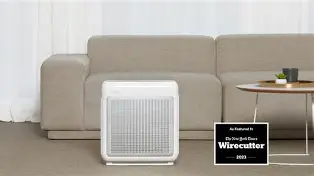
Unlike its sibling, the AP-1512HH, which features a prominent circular vent that resembles a classic iPod Shuffle, the Airmega 200M opts for a more industrial, "mesh-heavy" square aesthetic. It is available in both black and white finishes, allowing it to blend into contemporary decor more effectively than many of its competitors. The air intake is located at the front, which means you can technically place it against a wall, though leaving a few inches of clearance is always recommended for optimal airflow. The purified air is exhausted out the top, which helps circulate air throughout the room rather than just blowing it across the floor.
The control panel is located on the top surface, featuring physical buttons rather than the capacitive touch sensors that have become common (and often frustrating) in modern electronics. This design choice is a significant plus for users who prefer tactile feedback and want to know that their button press actually registered. The interface includes controls for fan speed (1, 2, 3), a toggle for the Eco mode, the ionizer switch, and a filter reset indicator.
Pros and Cons
- Consistent Performance: The True HEPA filtration is remarkably consistent, outperforming many higher-priced "smart" purifiers in pure particulate removal.
- Eco Mode Efficiency: The Eco mode is one of the smartest features in the electronics space; if the air remains clean for 30 minutes, the fan shuts off entirely to save power, only waking up if the sensor detects a drop in air quality.
- Manul Controls: Physical buttons are durable and less prone to failure or accidental triggers by pets or children compared to touch screens.
- Manageable Noise Levels: On its lowest setting, the device is virtually silent (about 24 decibels), making it perfect for light sleepers.
- Compact Size: It packs a high CADR into a frame that is small enough to sit on a side table or tuck into a corner without being an eyesore.
- Thin Carbon Filter: The deodorization filter uses a thin matting rather than granular carbon, which means it saturates quickly and isn't a powerhouse for heavy smells.
- Bright LED Lights: The air quality indicator light is quite bright and can be distracting in a dark bedroom, though it can be turned off on some versions.
- Ongoing Filter Costs: While the unit itself is reasonably priced, genuine Coway replacement filters can be expensive over the lifetime of the product.
- Ionizer Utility: While included, the ionizer creates trace amounts of ozone; though within safety limits, many health-conscious users prefer to leave it permanently disabled.
Comparison With Competitive Models
To truly understand the value of the Airmega 200M, it is helpful to compare it to other popular models in the same price bracket. This allows buyers to see where the 200M wins on raw specifications and where it might be lacking in modern "smart" features.
Discover deals on Electronics — updated daily.
View Offers →| Feature | Airmega 200M | Levoit Core 300 | Blueair Blue Pure 411 |
|---|---|---|---|
| Max Room Size | 361 sq. ft. | 219 sq. ft. | 161 sq. ft. |
| Sensor Type | Integrated Particle Sensor | None (on base model) | None (on base model) |
| Filtration | 4-Stage (HEPA/Carbon) | 3-Stage (HEPA/Carbon) | 2-Stage (Cloth/HEPA) |
| Auto Mode | Yes (Eco included) | No | No |
| Noise (Min/Max) | 24.4 - 53.8 dB | 24 - 50 dB | 17 - 46 dB |
Buying Guide: Is the Airmega 200M Right for You?
Buying an air purifier is an investment in your home's infrastructure. Before pulling the trigger on the Airmega 200M, you should evaluate your needs across several key categories.
1. Room Volume vs. Square Footage
Manufacturers often list square footage based on 8-foot ceilings. If you live in a loft or a home with vaulted ceilings, the 200M will have to work much harder. For high-ceiling rooms, it is better to "over-buy" on CADR capacity. The 200M is best suited for standard-height rooms where the air volume is manageable.
2. Primary Pollution Concerns
If your main concern is seasonal allergies (pollen, ragweed) or pet dander, the 200M is an elite choice. Its HEPA filter is specifically designed for these larger particulates. However, if you live near a highway and are concerned about traffic-related nitrogen dioxide, or if you are a heavy indoor smoker, you may need a unit with several pounds of activated carbon, which the 200M does not possess.
3. Sensitivity to Noise
Electronics in the bedroom need to be quiet. The 200M is excellent on its two lowest settings. However, speed "3" is loud enough to interfere with a television or a conversation. If you plan to run the unit in a space where you are always present, you'll likely leave it on Speed 1 or 2, which reduces the effective CADR. Make sure the CADR at Speed 2 is sufficient for your room size if silence is a priority.
4. Maintenance Responsibility
The Airmega 200M requires a specific cadence of care. The pre-filter should be vacuumed or washed every two weeks to keep the unit running efficiently. The carbon filter typically needs replacement every six months, and the HEPA filter once a year. If you are the type of person who forgets to change the oil in your car, you might want to look for a unit with "smarter" app integration that sends push notifications to your phone, as the 200M relies on simple onboard lights.
Detailed User Use Cases
To help visualize how the Airmega 200M operates, let's look at three typical scenarios where this device is commonly deployed.
The Home Office Professional
For someone spending 8 to 10 hours a day in a 12x12 room, the air can become stagnant. Dust from paper, skin cells, and printer emissions can degrade focus. The 200M is a favorite for this "small-room" high-intensity usage. Because it is compact, it fits under a desk or in a corner. The professional benefits from the "Eco Mode," which keeps the air fresh during the day but saves power once the office is vacated in the evening.
The Multi-Pet Household
Pet owners often deal with "pet smell" and floating hair. While the 200M won't replace a vacuum cleaner, its front-facing intake is excellent at pulling in floating dander before it settles on furniture. Frequent cleaning of the pre-filter is mandatory here, but the result is a noticeable reduction in the distinct scent of a "dog house" or "cat room," especially when the ionizer is activated to assist with odor molecules.
Discover deals on Electronics — updated daily.
View Offers →The Urban Apartment Dweller
In city environments, opening a window often lets in more soot and "city dust" than fresh air. The 200M acts as a gatekeeper. By keeping the unit running in a central hallway or near the main entry, apartment dwellers can maintain a "clean zone" despite the pollution occurring right outside their door. The 200M's ability to handle 360 square feet is perfect for most studio or one-bedroom layouts.
Technical Reliability and Long-Term Value
One of the reasons the Airmega series (and its Coway predecessors) remains popular is the mechanical reliability. In the world of consumer electronics, "planned obsolescence" is a common frustration. However, the 200M uses a robust AC motor and a simple centrifugal fan design that has been proven over decades. There are very few moving parts to fail, and because the filters are standard sizes, there is a robust market for both genuine and high-quality third-party replacements.
From an energy consumption standpoint, the 200M is Energy Star certified. When running on low, it uses less electricity than a standard LED light bulb. Even on high, the power draw is comparable to a small floor fan. This low overhead makes it one of the more economical electronics to leave running 24/7, which is the recommended way to use any air purifier for maximum health benefits.
The Verdict: Should You Buy It?
The Airmega 200M is not the most advanced air purifier on the market. It lacks Wi-Fi connectivity, app control, or integration with smart home assistants like Alexa or Google Home. For some tech-savvy buyers, this might feel like a dealbreaker. However, for the majority of users, these "smart" features are distractions from the actual goal: cleaning the air.
If you want a device that you can "set and forget," the 200M is arguably a top-three contender in its class. Its "Auto Mode" is genuinely intelligent, its filtration is medical-grade where it counts, and its build quality suggests it will last for five to ten years of continuous use. You should buy the Airmega 200M if you prioritize performance, reliability, and cost-effectiveness over digital bells and whistles. You should skip it only if you have massive rooms (over 500 square feet) or if you absolutely require smartphone control to manage your home appliances.
Ultimately, the Airmega 200M represents a "sweet spot" in household electronics. It does one job—filtering air—and it does it with a level of efficiency that many more expensive, flashy units fail to match. By focusing on the fundamentals of airflow and particulate capture, Coway has delivered a tool that significantly improves indoor environmental quality without complicating the user's life.
Conclusion
In conclusion, the Airmega 200M stands as a testament to the idea that sometimes the best technology is that which stays out of the way. It offers a powerful 4-stage filtration system, a smart Eco mode, and a design that fits seamlessly into the modern home. While it may lack the granular carbon necessary for serious chemical removal and the app-based features of some modern competitors, its raw cleaning power in moderately sized spaces is virtually unmatched at its price point. It remains a gold standard for those who value sleep quality, allergy relief, and long-term durability in their home electronics. Before making your final decision, measure your space and evaluate your primary pollutants, but if your needs align with what the 200M offers, it is a purchase you are unlikely to regret.